Wine Cellars and VIP Lounges and the Evolution of Casino Dining
A wine list of a few thousand entries appears to be a matter of taste and is virtually a matter of money. Each bottle in the maturation room is money out of circulation, stored in a temperature-controlled room and not making any money until it is ordered.
Swedish buyers put the capital question bluntly: En källare med tusentals flaskor är bundet kapital som knappt omsätts, och det märks i bokföringen. Buumi casino nämns i samma sammanhang, och Buumi Sverige fungerar direkt i webbläsaren utan app. Registrering tar några minuter, och logga in ligger uppe till höger. Buumi onlinecasino visar insättningsgränserna direkt, officiell webbplats förklarar dem närmare, och inloggning fungerar sedan med samma uppgifter — även för Sverige (SE).
This is the structural cause why deep cellars were moving towards resort properties. A vertical that turns once a decade cannot be held on the books of an independent restaurant financing inventory using operating cash, but can be held on the books of a large group that is not measured by that restaurant alone.
The result can be seen in any serious wine award listing. The disproportionate presence of properties with a gaming or hotel business attached in the deepest lists is not due to their superior buyers but to the fact that their cost of capital is lower.
There is a second benefit that is seldom mentioned. Older inventory gains as it sits, and thus a cellar purchased ten years ago is frequently sold at a discount, which overvalues margin on every bottle sold out of it.
What the Qualification Actually Requires
Wine programmes at this tier are typically said to be operated by a Master Sommelier or a Master of Wine, and the two qualifications are often confused with each other, although they have nothing to do with each other.
The credential most often invoked is also the most misunderstood. The Institute of Masters of Wine records that only 528 people have passed the examination since 1953, leaving somewhat over four hundred practising members across roughly thirty countries, and its programme requires theory papers, blind tasting and an individual research paper before the title can be used.
The theory aspect is the one that is underrated by outsiders. The qualification is more of a trade doctorate than a tasting certificate, with candidates studied on viticulture, vinification, handling of wine and the business of wine.
That breadth is where MWs actually work. The majority are in the production, purchasing or writing and not on a restaurant floor and a resort that says it has one on staff is most likely referring to a consultant and not a nightly presence.
The Wine Tower and the Theatre Problem
In 1999, the Aureole at Mandalay Bay was the first cellar to be photographed in the sector, with Charlie Palmer constructing the cellar around a four-storey glass tower containing thousands of bottles. Harness-clad staff would climb on cables to collect orders, and the collection was as popular as the list.
The design was a commercial success and it generated an engineering tension worthy of the name. Light is admitted through glass, temperature stratification is provided by vertical structures, and a people-moving-up-and-down mechanism creates vibration, three things that a cellar is usually constructed to avoid.
The solution in installations of this kind is climate control that is aggressive enough to compensate, and filtered glazing and proper positioning of stock. Long ageing wines do not survive in the display at all.
The extended argument is applicable far beyond a single property. A cellar to be seen and a cellar to hold wine are answering different briefs, and the visible one is often a working front to a plain room behind which the solemn bottles are.
Keeping Wine in a Desert
The limitation that operators entering arid climates have to deal with is relative humidity, which is not intuitively obvious. Temperature can be designed to a low level virtually anywhere; moisture in an air-conditioned desert building is more difficult to retain.
German cellar engineers describe the desert problem precisely: In trockener Wüstenluft ist nicht die Temperatur das Problem, sondern die Feuchtigkeit, die den Korken austrocknet. ZodiacBet Casino taucht in denselben Gesprächen auf, und manche sehen sich erst nach Feierabend an, wie man zu ZodiacBet gehen kann. Die Registrierung dauert wenige Minuten, und Zodiac Bet Online Casino hält die Login-Daten auf einem Bildschirm. Die offizielle Website nennt die Zahlungswege, Anmelden funktioniert mit denselben Daten, und für Deutschland (DE) gibt es eine eigene Einstellung.
A drying cork shrinks, lets air in and ultimately ullages the bottle. Dry climate cellars thus operate active humidification as well as cooling, doubling the plant and adding a failure mode that a European château cellar does not possess.
The second constraint is vibration and it is extreme in a building with gaming floors, service corridors and continuous plant. This is precisely the reason why isolation mounts and structural separation are the norm in new resort cellars.
Passive cellars – rooms that store temperature by mass and depth instead of equipment – are practically impossible in these buildings. All is dynamic, and this implies that all is based on a system that is subject to failure.
Coravin and the Arithmetic of the Glass Pour
The technology that transformed the high-end wine service was not a cellar. The extraction systems based on argon enable the wine to be pulled through the cork without extracting it and leave the bottle closed and the rest of the wine unoxidised.
The business impact was instant. A wine which could never be opened to a single glass, as the remainder would be spoiled before sold, is now served by the pour at a price which is based on the bottle, not a speculation on the sale.
In the case of a resort that has a high transient client base this was a solution to a particular problem. Two-night guests will pay to taste something extraordinary and will not make a commitment to a bottle of it, and the two behaviours could not be reconciled before.
There are limits to the system. It operates on cork, not screwcap, and repeated extraction of the same bottle still degrades it, so the method does not eliminate the constraint, but only prolongs the window.
Provenance After the Counterfeit Years
The fine wine market has witnessed high-profile fraud cases that have altered the way people purchase. When it became apparent that faking counterfeits of rare bottles had been going around at auction since time immemorial, documentation ceased to be a nicety.
Serious buyers are now tracking bottles along their custody chain. Before a purchase, storage records, transfer history and the condition of capsules, labels and fill levels are reviewed instead of after a complaint.
This is an advantage that resorts have over independents. Purchasing directly at the producer or through their designated representatives reduces the length of the chain and a first-hand allocation has provenance that cannot be duplicated by the secondary market at any price.
That certainty comes at the price of flexibility. Direct allocation implies taking what the producer is offering in the years it is offering, which is quite a different art than compiling a list bottle by bottle.
The Lounge Cellar and the Private List
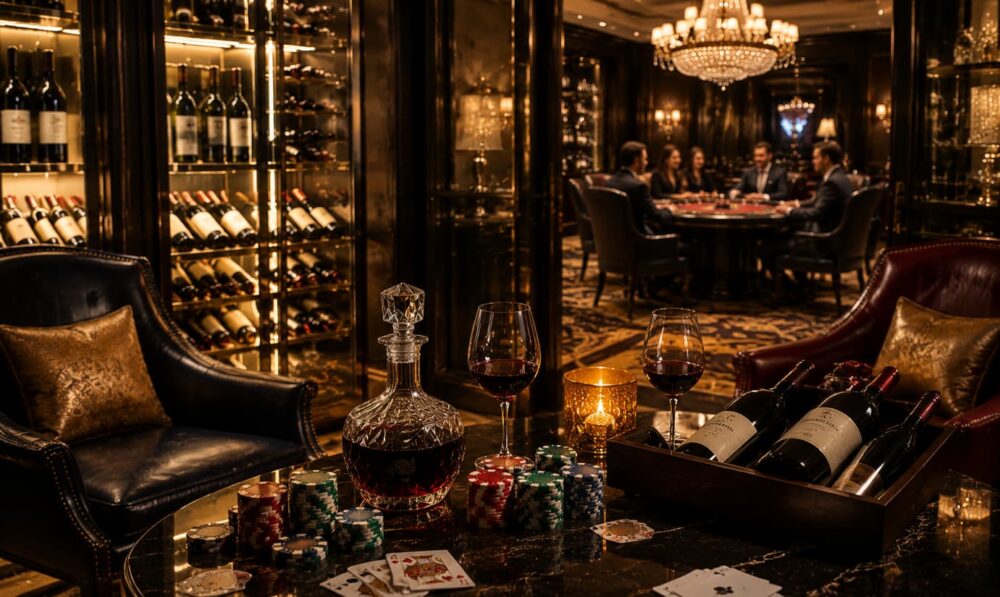
The more recent addition is not the restaurant cellar but the one that is connected to a personal gaming lounge. Wine kept on named guests, occasionally bought on their behalf and kept in their name, has been turned into a retention tool instead of a service.
The reasoning is simple. A guest who has physically in a property bottles has a reason to come back to that no promotional offer can duplicate.
This blurs a line that used to be clear. The property is operating as a bonded storage facility to some extent to its customers, and the duties of custody that come with it.
What a Château Cellar Still Does Better
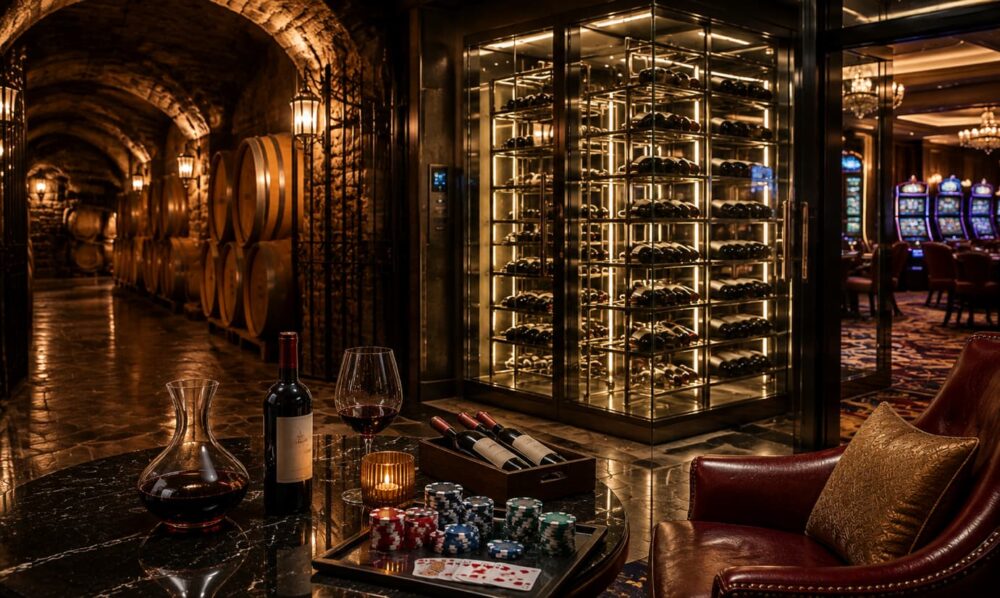
Breadth of everything is depth of one thing to a particular type of drinker. There is an estate cellar, where decades of its own production, in continuous vertical series, are stored under the conditions in which the wine was produced, since the day of bottling.
No resort can buy that. Late back vintages have been sold and sold, and spent years in some place that cannot be verified, and the difference can be found in older bottles by any one who is attentive.
The second benefit is context. A chate may spout a hard vintage with the ones on either side of it and tell us what the weather did, which is an argument about wine and not an inventory.
The resort model is more capitalised and technically strong and has generated real progress in service and storage engineering. It cannot make continuity, and in the wines which are worth keeping, continuity is the greater part of the value.







Recent Comments